What is Transactional Analysis?
Transactional Analysis (TA) looks at how we relate to ourselves and to other people. It helps you notice old messages from the past that still shape how you think, feel and act today, so you can let go of the unhelpful ones and choose new ways of responding.
Where it comes from
TA was developed in the late 1950s by the psychiatrist Eric Berne. The name comes from his interest in “transactions”, the everyday exchanges between people, and what they reveal about us.
Berne trained in psychoanalysis but grew frustrated with how closed and elite psychiatry could be, with ideas wrapped in language only professionals understood. He set out to create something anyone could understand and make sense of, using everyday words like Parent, Adult and Child, and treating client and therapist as equals.
Parent, Adult and Child
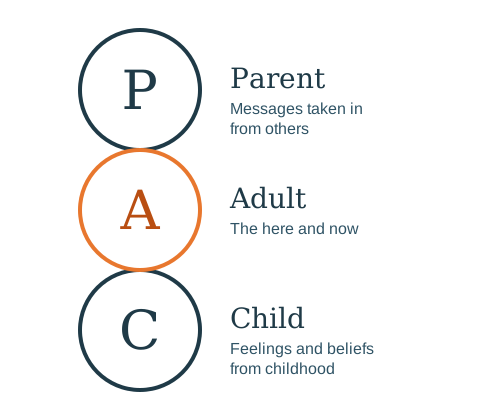
At the heart of TA are three “ego states”, three ways each of us thinks, feels and behaves.
Parent
Adult
Child
Old messages
Many of the messages stored in our Parent and Child are helpful. Some aren’t, and often we don’t know they’re there. When they slip into our Adult, we end up reacting to today using out-of-date information.
An example
A child who’s often told “Behave” or “Be quiet” may come to believe that it isn’t safe to be themselves. TA calls this an injunction: “Don’t be you”. As an adult, that person might find themselves masking, hiding who they are in everyday situations. Other people then respond to the mask, not the person, which creates problems of its own.
Other key ideas in TA
Short introductions to some of the other ideas we might draw on in our work together.
Transactions
Every exchange between two people, a word, a look, a tone of voice, is a “transaction”. Noticing which part of us is speaking, and which part of the other person is answering, can explain why some conversations go well and others go wrong.
Strokes
A stroke is any form of recognition, from a smile to a compliment to a criticism. We all need them, and the strokes we learned to seek and accept as children can shape how we let others treat us now.
Games
Games are repeated patterns between people that end with the same familiar bad feeling, often without anyone meaning them to. Spotting the pattern makes it possible to step out of it.
Life script
In childhood, each of us forms an unconscious plan for how our life will go, built from the messages we received. TA helps you notice where that script is still steering you, and rewrite the parts that no longer fit.
I’m OK, You’re OK
A core belief in TA is that people are OK. We all have worth, even when some of our behaviour doesn’t serve us. It’s why TA treats client and therapist as equals.
Contracts
In TA, you decide what you want from therapy, and we agree it together as a “contract”. It keeps the work focused on your goals, and you can change it at any time.
How TA therapy works
Build the relationship
Explore old messages
Understand them
Write new messages
What sessions are like
TA is my main approach and the one I’m trained in. But all the theory in the world can’t replace being with someone who listens and accepts you as you are, and that sits at the centre of how I work.
Sessions can be as structured or as open as suits you. Some people find it helpful when I share TA ideas, sometimes with a simple diagram, because it gives them somewhere to hang their thoughts and spot patterns. Others would rather simply talk and be heard. Both are fine.